

Have you ever walked into a room and felt a kind of discomfort you couldn’t quite name? A vague restlessness, a barely there irritation, nothing you could point to, yet something in you simply couldn’t relax.
You find yourself passing through the space rather than resting in it. Perhaps there’s a part of your home that comes to mind for you now? Something I’ve noticed, in my 37 years of living, is that my nervous system always knows when I feel relaxed before my mind does. It knows when something’s off. It knows when I’m feeling safe. And yet, until fairly recently, I hadn’t really learned to trust that quiet, interior knowing. To feel into it, rather than think my way around it.
Finding the peace
Our homes are in constant conversation with our nervous systems. Through light, texture, colour and sound. Through the things we’ve hung on the walls and the clutter we’ve stopped seeing. Or perhaps the warmth of a lamp in the corner or the particular cold of a room with too many hard edges. It doesn’t happen in the thinking part of us, it happens somewhere more intuitive and knowing. Which is why some spaces let you exhale the moment you arrive, while others keep you ever so slightly on guard, even when you can’t quite explain why.
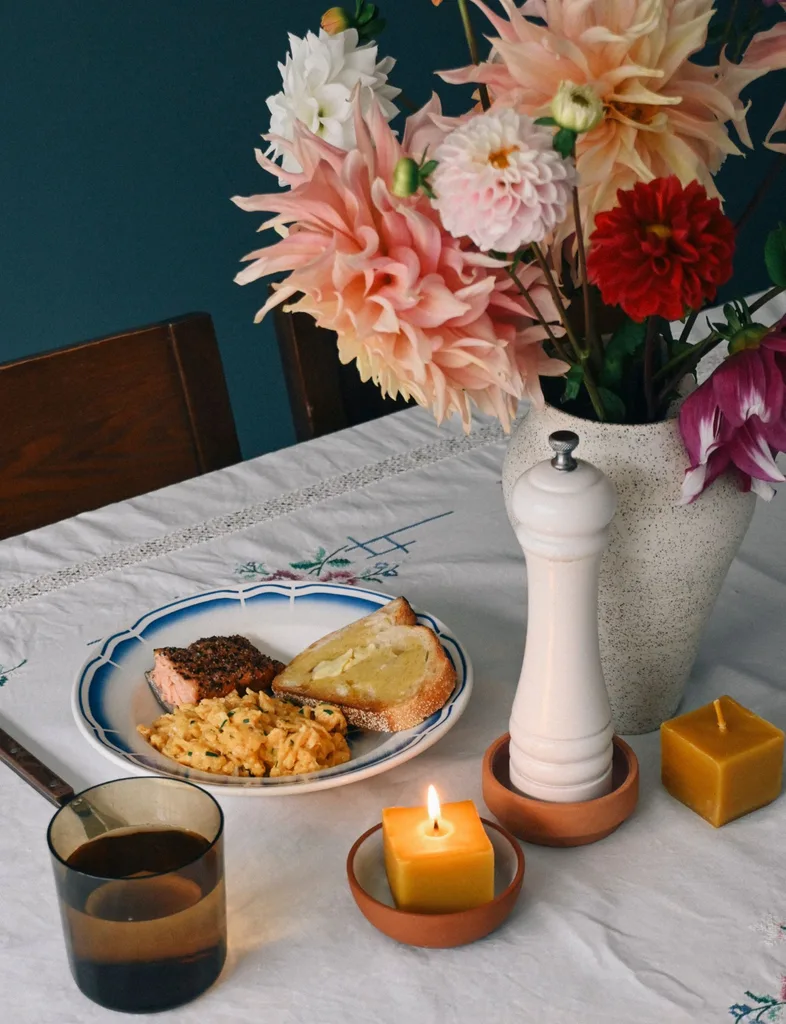
I understood this most clearly, and unexpectedly, during the newborn weeks after our fourth baby was born. The world had shrunk, as it does in those strange, suspended early days, to one room, one lamp, one small and perfect person. I was anchored to our small spare bedroom in a way I hadn’t been in years: long, slow hours in bed, pillows and blankets galore, the hush of a sleeping baby and the particular unglamorous tenderness of new motherhood. And what moved me, somewhere between the feeds and the exhaustion, was how held I felt. Not because the room was beautiful from a design perspective, but because it was safe. Soft. Mine. Something shifted in me during that time. A quiet awareness of how our surroundings can have more of an effect on how we feel than we might realise.
Read the room (and yourself)
Most of us were never taught to think of our homes this way. We were taught about aesthetics: colour palettes and furniture arrangement and whether things ‘go well together’. But I think the more useful question, the one our bodies are actually asking, is: how does this make us feel?
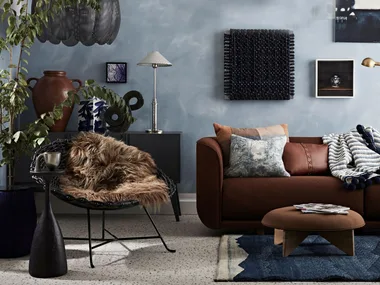
For me, when a space is working against me, I notice it physically before I notice it consciously. There’s a low restlessness, an itch to leave the room. It’s taken years to recognise this as essential data. Information my nervous system is offering me about my surroundings. And when a space is working for me? I exhale. My shoulders drop. I can sit still, think slowly and feel like myself. The room that does this most reliably in our home is our lounge. Warm-toned walls, ambient rather than overhead lighting, layers of texture in the cushions and throws, rattan baskets and the pieces of vintage art we chose over many years. It doesn’t look like a showroom – it looks like us. And that, I think, is why it feels so lovely.
Softening the hard edges
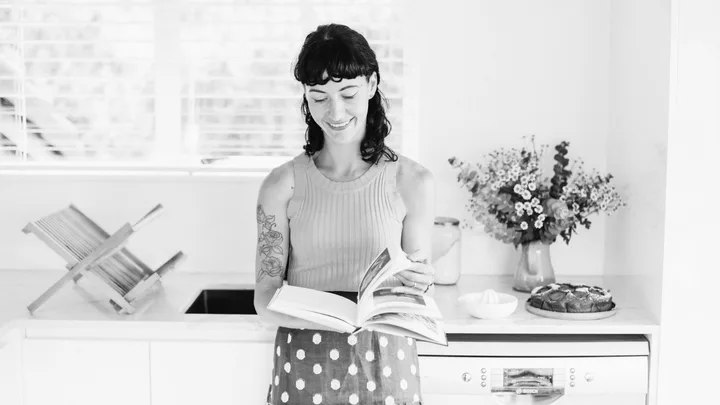
One of the things I’ve noticed is how much our nervous systems respond to texture. Hard surfaces, tiles, stark countertops and angular furniture – these sharp edges can keep us, just barely, on alert. It’s subtle and it’s biological: we are wired to read our environment for safety – and softness reads as safe. This is why a kitchen with a linen tea towel draped over the oven handle, a ceramic bowl of fruit on the bench and a textured rug underfoot feels different to one that is all angular edges and gleaming surfaces. One says come in, settle down and stay. The other says hurry up, you’re in the way. I’m not saying to remove these pieces, but rather to soften them. A cushion, a basket, a touch of something organic to bring things back into harmony.
Reducing the sensory load
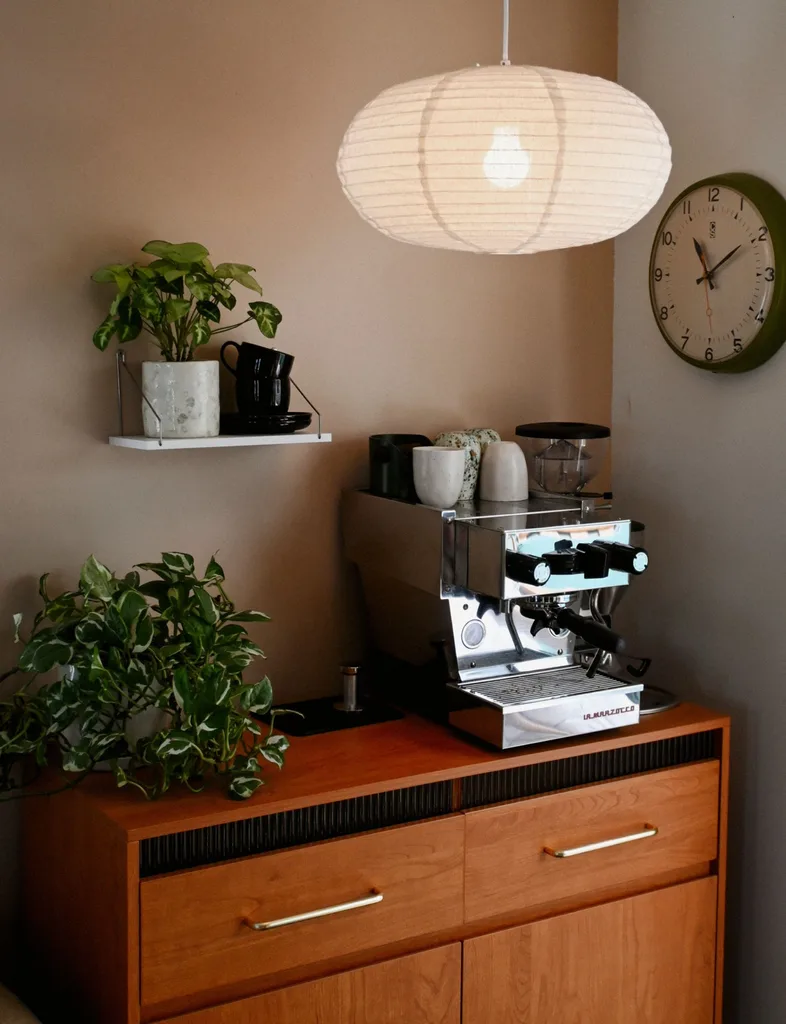
We live in a time of enormous visual noise and we’ve imported a lot of it into our homes. Surfaces stacked with things. Screens glowing in the corner. Clutter that doesn’t belong anywhere specific, so it belongs everywhere. Every object in our eyeline is something our nervous system has to process, file and decide whether it makes us feel safe or not. This isn’t an argument for minimalism – not at all. I have a pinboard covered with postcards and photo booth strips and I love every chaotic inch of it. What I’m talking about is the difference between collected and accumulated without intention. Between things that are there because we love them and things that are there because we haven’t considered them. One nourishes. The other depletes.
There are some switches you can try instantly: swapping harsh overhead lights for lamps. Containing clutter in beautiful baskets so it’s held rather than sprawling. These small acts are, in my opinion, genuine acts of self-care.
Bringing nature in
There’s a reason we feel different standing in a garden or walking under trees. Our nervous systems were built for enjoying nature – for the particular quality of natural light, the irregularity of organic shapes, the faint aliveness of things that grow beautifully.
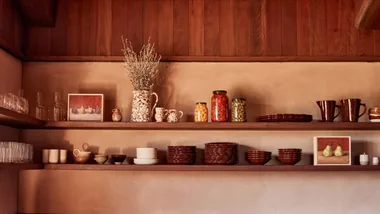
A home that borrows from this needn’t look like a greenhouse (although I do always desire more plants). There are other ways you can bring nature indoors. A wooden bowl. Foliage in a vase. Earthy colours that reference soil, stone and bark.
The comfort of the familiar
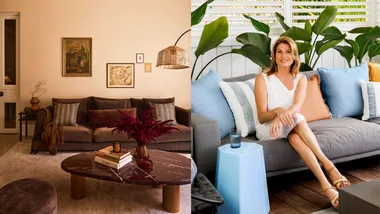
Something I’ve found unexpectedly profound is how much our nervous systems love predictability. Not sameness for its own sake, but the gentle anchor of ritual. The same lamp switched on each evening. The same mug for your morning coffee. The same corner of the sofa that is implicitly yours. These small consistencies tell the body: we’ve been here before, we’re okay, nothing is required of you right now. It sounds simple. But for those of us who move through days that are relentlessly full and frequently unpredictable, it matters more than we might expect.
Your exhale spot
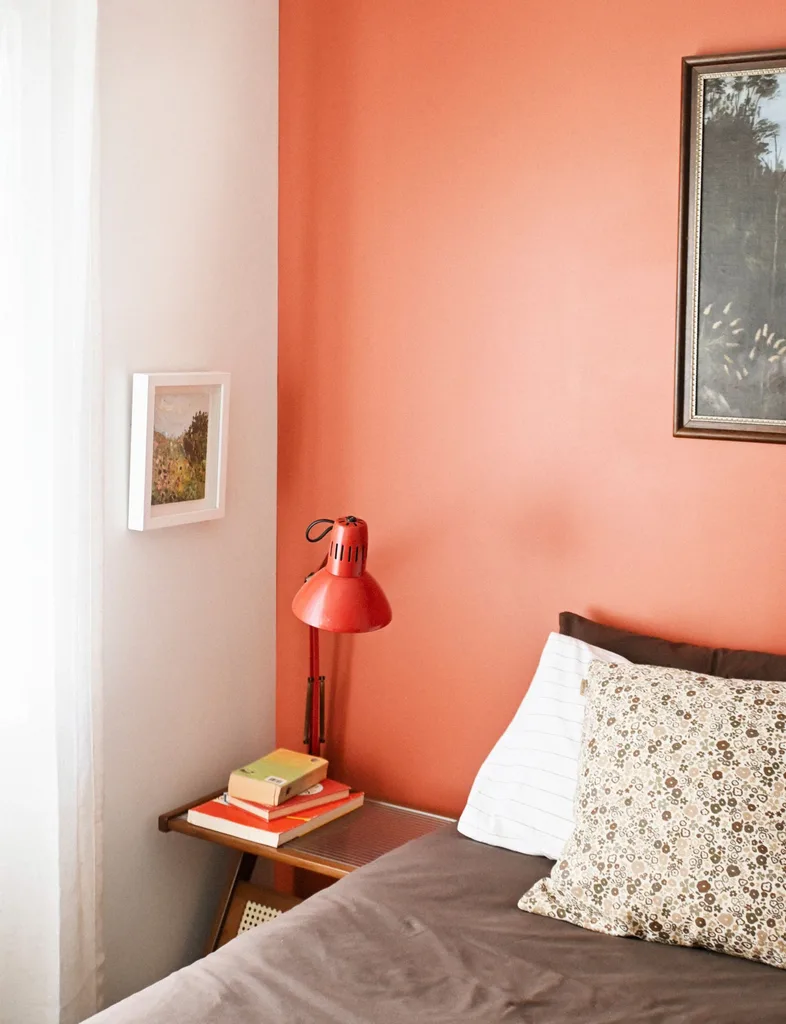
I want to suggest something that feels a little indulgent but is, I promise, entirely necessary: create one place in your home where nothing productive lives. No piles. No to-do lists. No laundry waiting to be folded. Just a chair by a window, or a corner with a lamp and a good book, or a spot on the sofa where the light falls exactly right in the late afternoon. You know the spot. You probably already have one, even if you haven’t named it yet. The place you gravitate toward when the day has been a lot. Where something in you goes, oh, this is for me. It doesn’t need to be grand or decorated or particularly considered. It just needs to be yours.
Trust what your body says
I think the most important shift in all of this is less about what you do to your home and more about how you learn to listen to yourself within it. Your body knows before your brain does. The tension in your shoulders is information. The relief you feel when you walk into that one room is very important information. The way you find yourself lingering in the kitchen when the evening light comes through, or always gravitating toward a particular corner, that’s not random. That’s your nervous system telling you what it needs.
We spend a lot of time curating our homes for how they look. But might I suggest curating them, even just a little for how they feel? You don’t need to make any grandiose changes. A softer light, a cleared surface, one thing that makes you smile when you see it. Start there.
Read next:
- Spring reset: A guide to decluttering and organising
- Jayne Kiely’s tips on adding value to your bedroom & living spaces
- The art of hygge: How to make every room feel warm and inviting

